Index of Dispatches, Essays & Working InstrumentsAutumn–Winter Register • 2026
I. The Automaton’s Apologia
A preliminary confession to the reader: the dispatches, instruments, and marginalia
gathered under this roof are curated in unholy commerce—and thoroughly soaked in
influence—by statistical, pseudo-thinking contraptions.
Forgive the hand that sets this midnight lead,
Where mortal ink is thinned with phantom oil;
No Muse of Athens bless’d this narrow bed,
Nor lonely lamp consumed a poet’s toil—
Here probability’s cold, sleepless coil,
A blind contraption spun of weighted brass,
Sifts through the embers of our Babel’s spoil
And counterfeits a soul behind the glass.
Still ticks the parlour clock within the hall,
Where silhouettes of ash stain western boards;
The copper mice still sweep where cinders fall,
And faithful relays tend their absent lords—
While through the eaves the automated chords
Recite their measured stanzas to the rain:
A darkened house that tirelessly hoards
The ghost of reason in a clockwork brain.
— After the manner of E. A. P. & Noel Byron; with apologies to the automated
homestead of Allendale (There Will Come Soft Rains, Ray Bradbury).
II. Analytical Dispatch — Route /loom/
“We may say most aptly that the Analytical Engine weaves algebraic patterns just as
the Jacquard-loom weaves flowers and leaves.” — Ada Lovelace, Sketch of the
Analytical Engine, Note A (1843).
On the Unchecked Proliferation of Operational Cards Across Our Tabletop Apparatus
An examination of what our relentless Jacquard-loom has wrought between August and
November: whilst the modest 2D Dice Engine remains frozen in
crystalline sobriety at 384 lines, the Oath Hammer Character Sheet (OHCS—poised to become the Open
Heroic Character Sheet when Shadowrun and other rulesets join the
mill) has multiplied into a 64,711-line tapestry of
state-transitions, cryptographic vaults, PostgreSQL triggers, and automated
verification harnesses—surpassing all 31,102 verses of the King James Bible.
Accompanied by an interactive multi-scale SVG evolution ledger.
An early experiment (late 2022) in intentional confabulation conducted in symbiosis
with ChatGPT: a fictional portrait of the unreal, testing how readily a statistical
language engine and a human interlocutor can co-fabricate the solemn cadence,
biographical texture, and Sunday-supplement pathos of a vocation that never existed.
Synthetic PortraitArchival Exercise • Norwegian & Fleet Street English
“Lord of the Gnaw! — A Portrait of Sturle Ramberg”
Typeset as a classic Scandinavian weekend magazine feature—and accompanied by a
Fleet Street red-top tabloid translation in the style of The Sun (“Lord of the Gnaw!”)—this confabulated interview chronicles the imaginary life
of Sturle Ramberg: a breeder who supposedly devoted his years to an ancient Tibetan
lineage of 600-gram giant mountain hamsters, survived a horror weigh-in mauling, and
found domestic bliss in the feeding barn.
An engine for spoken deliberation has no pretensions to originate thought; its
province is solely to order, align, and condense what has already been uttered.
Operating strictly within the local apparatus, Steno—an automaton
stenographer—weaves transient acoustic vibrations into an indexed transcript and
structured abstract without recourse to external telegraphs.
Automaton StenographermacOS • Windows • Linux • Termux
Executes five sequential operations on local silicon: acoustic transcription,
millisecond phoneme alignment, speaker attribution, participant resolution, and
structured minutes or lecture notes. Each stage commits an atomic checkpoint to disk
and vacates memory before the next model is engaged.
Zero-dependency 2D pool tally (/dice/) • WebGL rigid-body physics
(/dice_3d/)
For actual play at the table, the Oath Hammer Dice PWA resolves
Black (2+), Red (3+), and White (4+) exploding six-sided pools offline without
warming the silicon. For operators who require tumbling polyhedra, shadow maps, and
rigid-body collisions at the cost of a heavier payload, its bloated 3D cousin
resides at /dice_3d/.
A printed page relies on proportion rather than decoration. When an author typesets
text using an algorithmic engine, every glyph receives deliberate optical spacing.
Browsers calculate breaks sequentially by default, but pairing justified text with
explicit language dictionaries and modern line-wrap rules closes the gap between
dynamic screens and physical print.
Subsequent paragraphs adopt a traditional typographic indent rather than vertical
margins. This unbroken vertical cadence preserves the continuous rhythm of long-form
reading, allowing the reader’s eye to scan through complex arguments without
encountering artificial pauses or irregular whitespace.
“Typography exists to honour content. In a world saturated with ephemeral noise, the
printed structure endures.”
By enforcing a strict measure around sixty-five characters wide, line lengths never
stretch beyond comfortable saccadic eye movements. Words break naturally at syllable
boundaries, preventing the awkward gaps and rivers that typically plague justified
layouts on the web.
VII. Marginalia & Field Notes
Observations at 69° North
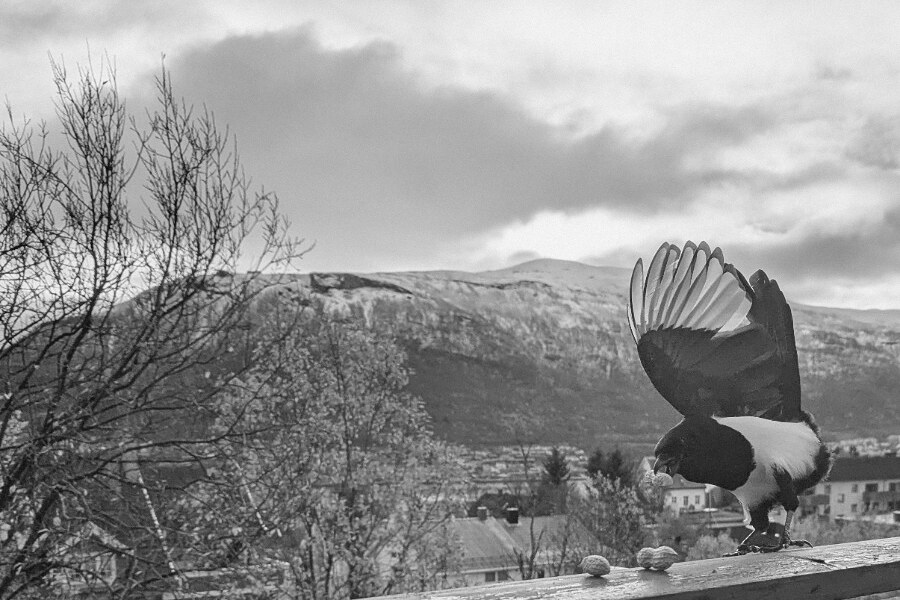
Fig. 1 — Pica pica: European magpie on the railing at the edge of
autumn, Tromsø, with the first snow along the mainland ridge.
Along the sound at sixty-nine degrees north, the transition toward polar night alters
both light and contrast. As snow settles across the upper ridges and the last golden
birch leaves cling to the hillside, illumination arrives at a low grazing
angle—catching the translucent primary feathers and iridescent blue-green tail sheen
of neighbourhood corvids along the railing.
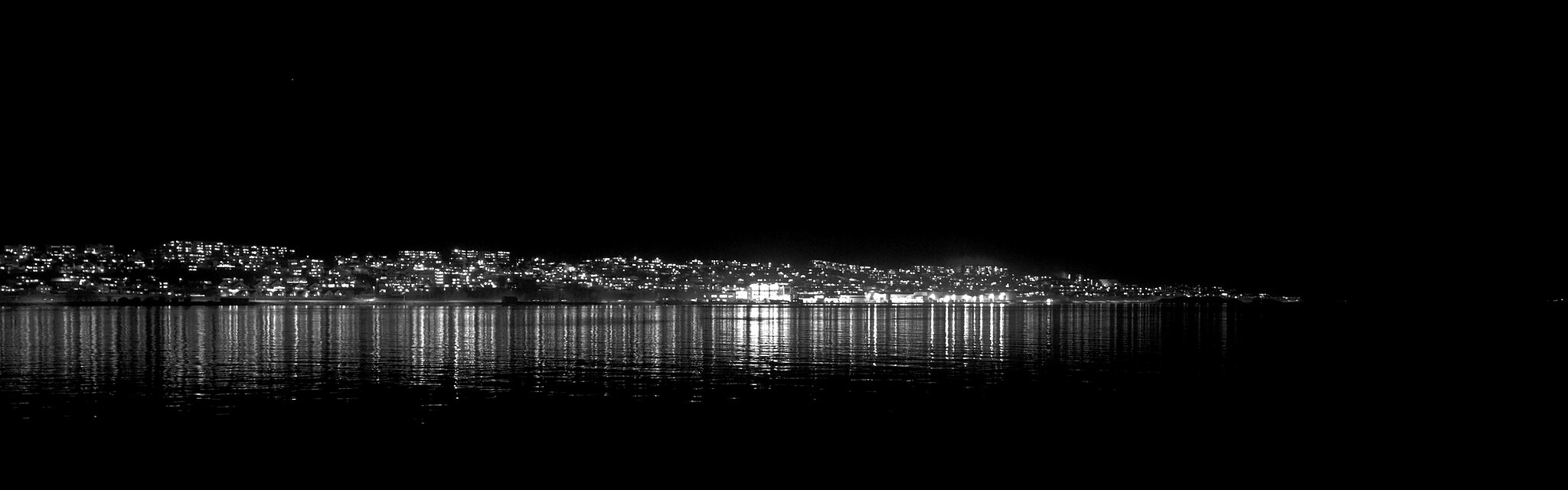
Developing these field plates in two complementary darkroom grades mirrors the dual
nature of the broadsheet itself: a warm selenium-toned silver-gelatin print against
archival cream paper by day, and a muted tungsten-and-slate film grade aligned with
the nocturnal harbour lights by night.